
On this website, I try to avoid commenting explicitly on Canadian politics. As a non-partisan public servant, I have a duty to neither openly praise nor criticize the elected government, and I take this responsibility seriously. As a result, I’ve spent much more time analyzing U.S. gun control policy and Australian immigration controversies than the most important matters in Canada. As much as I’d like to dig into these issues, this is usually not the place to do so.
But I would like to make an exception in this case and weigh in on the trucker protests that have gripped Ottawa. Not only because they have weighed on tens of thousands of people who live in my city, but also because the protests are being watched and emulated by activists around the world. The events occurring in Ottawa and at the border are unprecedented, internationally relevant, and right on topic for this blog. I would be remiss if I neglected to speak about them.
Before continuing, I’d also like to be explicit about one thing: I will not be addressing the worst of the protesters in this article. Yes, there were Nazi and Confederate flags brandished about the downtown core. Yes, many of the protesters have acted like thugs. Indeed, many of the methods used, from honking train horns in the night to assaulting mask-wearers, were contemptible. I have been blessed in living far from the action, and I don’t wish to overlook the strain that these protests have placed on many of my friends and colleagues. Neither do I wish to excuse the worst of the behavior seen recently in downtown Ottawa.
However, in order to analyze the moral values political movements, difficult choices need to be made about representation. Who speaks for a particular movement? Who is on the fringes? At what point, do the fringes become the movement? I don’t have answers to these questions, but in the case of the trucker protests in Ottawa, I will not allow the actions of racist and violent individuals to become the focus. Large-scale movements are made up of individuals, many of whom hold differing views, goals, and values. I could spend my time discussing the values of the white supremacists who participated in recent events, but I don’t see the point; they have nothing constructive to teach us about morality.
If we focus exclusively on these individuals, we risk misunderstanding the people who have something important to say. Most protesters who came to Ottawa were not white supremacists. They came to make a point, a point whose validity I will demonstrate throughout this article. After all, the values of this group are felt by all of us to some degree, even if this can be hard to see on the surface. This article will analyze these protesters by describing the most favourable moral argument for their cause and the common values that underpin their movement. I recognize that this article won’t illustrate the views of every protester, but it will describe at least one of them.
This brings me to my main point: this article is not an apology for the darkest elements of the protest, but rather a discussion about the protesters who are saying something worth talking about. Values Added is not dedicated to deconstructing right-wing extremist ideologies. There are better sources for that elsewhere.
In addition, the analysis that follows is not a criticism of federal policy, and it should not be interpreted as such. Rather, it is a description of the moral forces that have driven Canadians to spend their time in downtown Ottawa or at an international border crossing in the freezing cold (plus the moral forces that have driven the broader moral reactions to the Convoy).
With that said, let’s talk about the Freedom Convoy.
The What?
If you haven’t been paying attention to the news recently, here’s a brief recap. On January 15, 2022, a Canadian vaccine mandate for truckers crossing the Canada-U.S. border came into effect. All unvaccinated American truckers were denied entry to Canada, and unvaccinated Canadian truckers had to produce a negative COVID-19 test and quarantine upon returning from across the border. In practice, this policy ended the possibility of cross-border transits for unvaccinated truckers. A week later, the U.S. implemented similar restrictions.
Although Canada and the U.S. were aligned in their approaches to the border, a loud minority of truckers (many of whom were unvaccinated) were not pleased, and they organized a series of convoys that primarily traveled from the West Coast to Ottawa to protest the cross-border restrictions. As the convoys converged on the capital, more truckers and other vehicles joined in. With more people came more ideas. Although the Freedom Convoy (as it was dubbed) was originally intended to protest the cross-border restrictions, the movement expanded into a fierce challenge to vaccine mandates, lockdowns, and other measures intended to reduce the spread of COVID-19. Donations poured in from around the world, and the Freedom Convoy eventually amassed over ten million dollars in donations on GoFundMe, although the crowdsourcing site withheld the lion’s share of the donations.
On Friday, January 28th 2022, the Convoy arrived in Ottawa. Although most participants were moderately well behaved in the early days, some events received widespread condemnation. Protesters danced and drank on the Tomb of the Unknown Soldier, harassed mask-wearers, peed in a nearby mall, and seemingly made fun of Indigenous drumming. As mentioned earlier, a few individuals thought it appropriate to pull out their Nazi flags, but these individuals were few and far in between.
Oh, and they honked their horns. The noise was incessant and intolerable. Many people who lived in the downtown core reported extreme sleep deprivation and stress from the endless noise. Others described an intense of fear due to living near the trucker encampments. As the temporary protest transitioned into an occupation and standards of decorum for the protesters slid, local frustration became intense. Overall, two-thirds of Ottawa residents opposed the Convoy, with only about 22% expressing support. These figures resemble recent nation-wide polls, where 72% of Canadians want the protesters to return home and only 22% want them to stay in Ottawa.
Despite their overall unpopularity, the disruptions have radiated outward from Ottawa. Although attempts to hold similar rallies fizzled in Toronto and Vancouver, copycat demonstrations took place as far afield as New Zealand. The protestors tactics shifted when major blockades were set up at border crossings, most notably the critical Ambassador Bridge that links Canada and the United States, across which more than 10,000 trucks cross every day. Although this blockade was broken up by police after about a week of disruption, more continue to pop up. Eventually, events reached a tipping point. On February 14, the Prime Minister evoked the Emergencies Act to deal with the blockades. It remains unclear how this story will come to an end.
The Values
What were the values that provided the impetus to the Convoy? Obviously, people don’t drop everything, travel thousands of kilometers, and spend weeks outdoors in downtown Ottawa or at international border crossings during the winter for fun. To its participants, the Convoy was a crusade driven forcefully by their values. The people involved with the Convoy – and those who opposed it – believed that their cause was moral. When strong moral reactions are at play, we can use values analysis to better understand the issue.
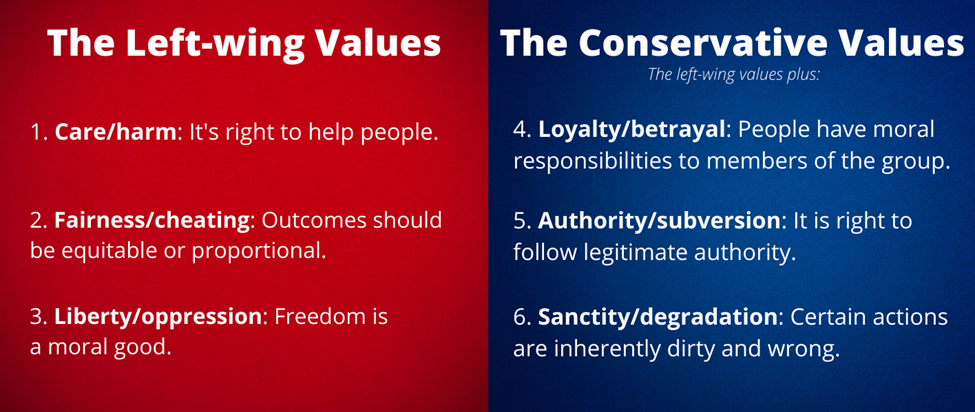
Let’s start with the Convoy’s opponents. As I have outlined in previous articles, the majority of the public health measures implemented during the COVID-19 pandemic have been justified on the Care value (i.e. causing pain is wrong, especially to the vulnerable). Simply put, vaccine mandates and other restrictions save lives, and, therefore, they are morally correct. This impulse has driven several policies that have altered Canadians’ lives to an exceptional degree, from massive cash payments to citizens to strict public health lockdowns. No doubt, the Care value continues to drive a significant portion of the population to support vaccine mandates.
Now for the Convoy. The central value of the protesters was Liberty (i.e. freedom and autonomy are moral goods). “Freedom over fear” was the rallying cry, and this moto was plastered all over the signs and placards carried by protesters. The same words were repeated by Conservative MP Pierre Poilievre, who has supported the Freedom Convoy since its inception. Here’s a few pictures of the protest. Have a look at the placards, and note their focus on the Liberty value:
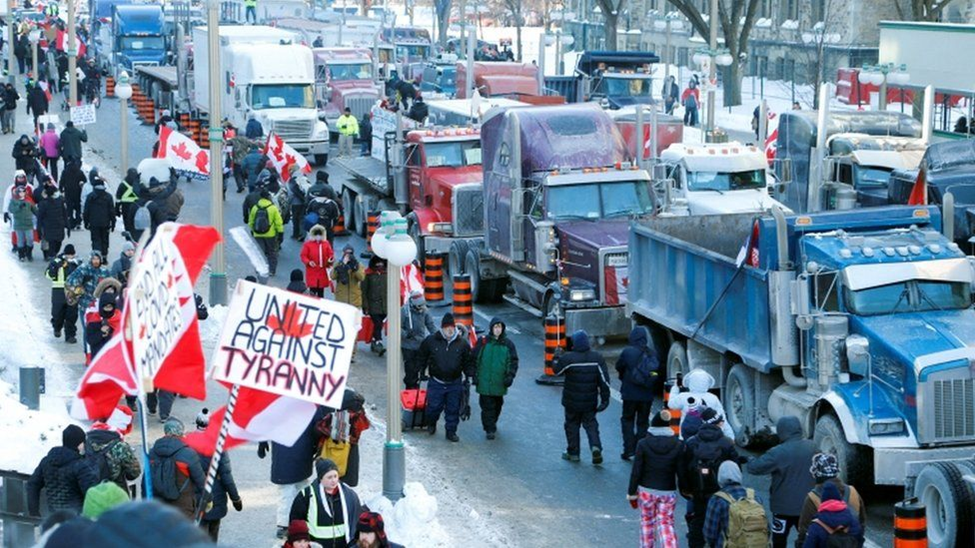
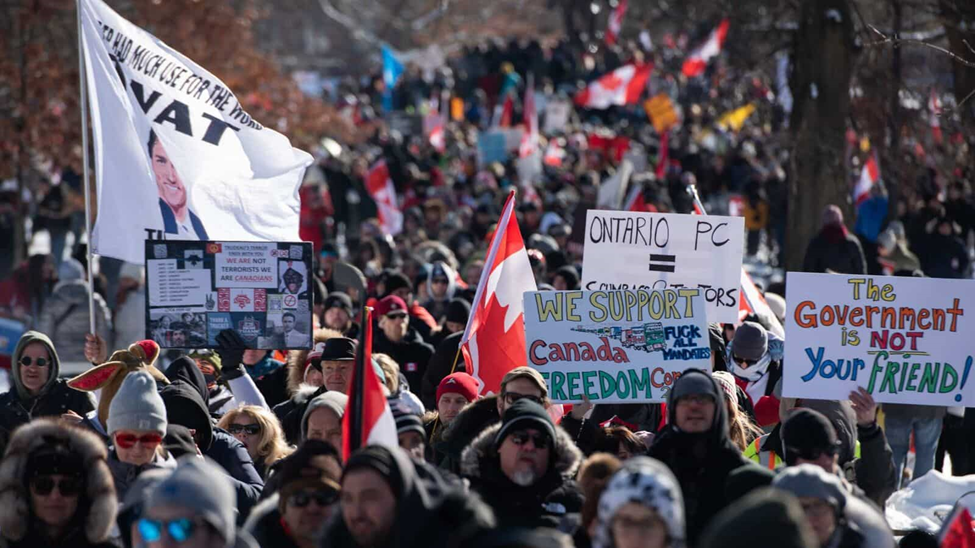

These individuals were clearly being driven by the Liberty value, and this isn’t surprising: in the conflict between Care and Liberty values during the pandemic, Care has consistently won out. Canadians have tolerated (and often supported) restrictions on their liberties that were unthinkable only three years ago. Presenting documents to enter at a restaurant is not normal in any country, much less a free one like Canada. Necessary though they may be, most people understandably don’t enjoy these measures. However, in weighing competing values, the democratic process selected the values that were most important in the current context. This meant that Care won out over Liberty in face of COVID-19.
Early in the pandemic, the vast majority of Canadians were in agreement with this arrangement. There was a broad consensus that lockdowns were worth to cost, and polls showed majority support for strict public health measures, even up until the end of 2021. In addition, vaccine mandates were on the ballot in the 2019 Federal Election, and pro-mandate parties won a solid majority of votes. Individuals who consistently opposed these measures found themselves on the political fringes in 2020 and 2021
Things have changed though: this consensus has collapsed in recent months. Support for lockdowns is tanking, and a strong majority of Canadians now believe that public health restrictions should be quickly relaxed or removed. No wonder that 46% of Canadians are sympathetic to the goals of the Convoy, even if they disagree with its methods. Of course, public opinion could shift again if the conditions deteriorate, but strict public health measures are no longer popular.
Values play a key role in this evolution. One of the first articles I wrote discussed the Government of Alberta’s efforts to avoid introducing vaccine passports. I noted that vaccine passports and other mandates violate the Liberty value, so it is no surprise that a libertarian-leaning Provincial government would explore every option before implementing a measure that was explicitly designed to restrict freedom. In the end, the Government of Alberta was forced to introduce a vaccine passport-esque program, implementing a policy that it clearly disagreed with morally. At the time, the political landscape still favoured the Care value, putting an emphasis on protecting vulnerable people and the health-care system. Democratic governments have to respect the moral views of their citizenry or they will be turfed at the soonest opportunity.
But conditions have shifted since then. Governance is often an exercise in balance, and the Care value can only guide action for so long before there is a counter-reaction. The widespread use of lockdowns and other public health measures during the COVID-19 pandemic was unprecedented and severely violated most Canadians’ concept of liberty. This could not continue forever. Values can only be violated (even justifiably so) for so long before grumbling turns into action.
In this way, the Convoy is completely understandable. Canadians pride themselves on their liberty. We believe it is a pillar of our social contract, and we use it to differentiate our society from more authoritarian ones. In addition, many Canadians have internalized an important lesson, often repeated every November 11: freedom isn’t free. Is it so surprising that, as we enter our third year of significant and expanding restrictions, some Canadians took this lesson seriously and decided to act?
To make matter more serious, Liberty is a particularly fertile value for political advocacy, because libertarianism, a widespread and influential political movement, relies almost exclusively on the Liberty value to guide its actions. This is a group that is willing to turn out in the streets for their beliefs, and they will stay there for weeks.
Again, I’m not here to argue for or against the Convoy. That’s not my job. I am here to describe the views of many of the protesters in the Convoy. These are the moral underpinnings of the movement, whether you agree with these sentiments or not. Some people will agree wholeheartedly with the goals of the Convoy and argue that once-prized values are being repeatedly violated. Others will instead focus on the vulnerable people that the Convoy puts at risk, the thousands of additional lives that could be lost if public health restrictions were rolled back too soon. The weighing of values is open to everyone. There are no experts; every single Canadian is equally qualified to make moral determinations for themselves. Collectively, with the help of a healthy, competitive political process, we land on an arrangement that we can all live with. That’s the only way to decide when to start or stop prioritizing Care over Liberty.
Conclusion
Everyone has a point where they say “enough is enough” with regards to restrictions on personal liberty. For some people, the bar is very high, and they would be willing to tolerate strong public health measures for a long time if it would save even one additional life. For others, even the slightest infringement on their liberty evokes a strong moral reaction. Most people are somewhere in the middle, prizing both the Care and Liberty values and weighing the two values in respect of current challenges. Although the Care value has dominated our decision-making over the last two years, the moral landscape is shifting. The Convoy is an expression of these underlying changes.