
Last week, I opened a discussion on the Freedom Convoy that occupied Ottawa and blockaded key international crossings for weeks. The Convoy was supported by a range of groups, some respectable and some abominable. I chose only to discuss the views of the more constructive groups, and I left the neo-Nazis, the thugs, and the white supremacists to be handled by writers elsewhere. Since values analysis is about understanding and accounting for people who hold different moral compasses, it is necessary to distinguish between the various sub-groups in a broad movement and to be explicit about the sub-groups under examination. Individuals hold a diverse range of values, and it is critical to make fair distinctions within movements when warranted. If this process of sifting is not undertaken properly, values analysis becomes an exercise creating strawmen, rather than truly accounting for moral preferences. In other words, it becomes useless.
With that said, my previous article outlined how Convoy was given moral force by the Liberty value (i.e. i.e. freedom and autonomy are moral goods). In short, the public health measures implemented to address the COVID-19 pandemic have repeatedly violated this value, as Canadians were forced to accept restrictions on their freedoms of movement that would have been unthinkable in the “Before Times.” For the first two years, people believed that the restrictions were morally justified, but this consensus has collapsed. A significant proportion of the Convoy was made up of individuals who value the Liberty value most, and they are most willing to protest (and to be arrested) for it.
I’d like to address another element of the Convoy which warrants discussion. Here are pictures of two different Ottawa protests. One is from the 2022 Convoy, and the other is the 2020 Black Lives Matter demonstrations. What does the Convoy have that the BLM protest did not?
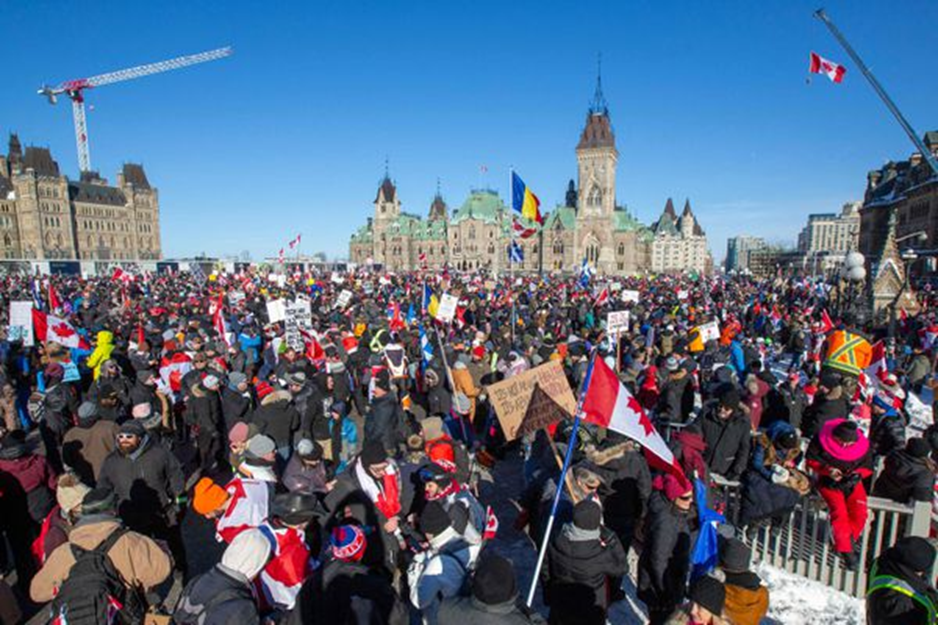

It’s the flags. At the Convoy protests, Canadian flags were everywhere. If anything was a symbol of membership in the Convoy, it was a Canadian or Quebec provincial flag (being waved, hanging off the back of a vehicle, etc.). The prevalence of flags was not restricted to the city of Ottawa. The border blockades probably boasted a higher flag-per-protester rate than in the capital.
But I can’t find a single Canadian flag in any picture of the BLM protest. Why is that? Both protests targeted government, calling out current policies as wrong and harmful. It’s not like the Convoy was a “pro-government” or a nationalist rally, where you might expect Canadian flags to be a common sight. For whatever reason, the participants in the Convoy felt an impulse to wave the national flag that did not appear to be held by the BLM protesters. I will explore two possible reasons why this could be true: for tactical reasons or for moral reasons.
The Tactical Answer
One possible reason why the Convoy was so attracted to the flag was because wrapping yourself in red and white is a keen political move; it makes your movement more attractive to the public. This argument was best made in the front-page Globe and Mail article Remember: Those who wave the Canadian flag do not get to define it for everyone else.
The article is part history lesson and part collection of quotes from horrified academics, who raised several reasons why the flag might have become so central to the Convoy. Dr. Will Langford, who studies right-wing extremist groups of the Cold War period at Dalhousie University, considered the flag to be a type of disguise, one that hides unpopular beliefs and makes them “appear respectable and within the bounds of what is acceptable.” Forrest Pass, a vexillologist at Libraries and Archives Canada, was even more cynical, suggesting the protesters might “be using the Canadian flag because the optics would look really bad if the police or authorities were to start to move the protesters and trucks out of the way.” Finally, University of Toronto History professor Robert Bothwell viewed the use of the flag to be a “partisan accoutrement”, noting that the protesters tried to position themselves as “true Canadians”, so anyone who disagrees are “attacking the essence of Canada.”
Well, that sure is a lot of conjecture, and no compelling evidence was presented to defend these claims. Not one protester was interviewed for the piece or even quoted within it, so the article was unlikely to accurately describe their views. Now, in my experience, academics are far more nuanced in their opinions than comes across in newspaper articles, where journalists attempt to sum up deeply held views in a few short sentences, if that. However, this probably doesn’t excuse this demeaning comment by Dr. Bothwell (although I leave open the possibility that it was taken out of context):
[The protesters are] expressing it as pure paranoia. Their signs are all about conspiracies and lies, about pulling the wool over the eyes of the average Joe. They say no vax, but that also means smallpox and measles and whatever else. When you really get into it, these guys pretty soon end up on all fours with wise women boiling herbs in a corner of the hut. It’s anti-progress, no question of that. And it’s kind of universal these days.
This isn’t a constructive comment. Rather, it is the type of thinking that contributes to poor analysis and ineffective policy. Are there conspiracy theorists and anti-vaxxers at the Convoy? Yes. Is the Convoy only about conspiracy theories or opposition of vaccination? Of course not. The movement is simply too large. A considerable minority of Canadians support the goals of the Convoy, and it’s hard to get that level of support on conspiracy theories alone. It’s not even true in a technical sense. Lots of the signs at the demonstrations expressed non-conspiratorial sentiments.
In addition, these explanations don’t explain why there would be flags at some protests, but not at others. If the flag is a disguise for less-than-popular views, why wouldn’t some of the BLM protesters have used it to make defunding the police (a broadly unpopular policy measure in Canada) more acceptable? Like all protest movements, BLM contains a wide range of individuals, some of whom hold fringe beliefs, and these individuals would be incentivized to reach for the Maple Leaf. In fact, if the flag produces tactical advantage, shouldn’t every protest use them? It seems like an easy way to improve your chances of success. But most protests in Canada prefer placards to national flags, and this demands an explanation that the Globe and Mail article doesn’t provide.
Overall, the tactical explanation for the rabid flag-waving at the Convoy are unconvincing, although they could have had a marginal effect. Again, movements are made up of individuals, and each person holds different reasons for taking actions. However, I’d like to present a different explanation, one that is rooted in values analysis:
The Values-based Answer
Here’s a thought: what if the Convoy protesters were flying the Canadian flag because they believed their cause was patriotic? And I don’t mean in a tactical or cynical way. It’s not about partisan advantage or disguising unacceptable beliefs or protection from authorities. Simply put, they believed themselves to be patriots, and so they waved the Canadian flag.
This is a much more convincing explanation for their behavior. It doesn’t require the protesters to be well organized, coordinated, or frankly, even particularly clever. It lacks the conspiratorial undertones of the explanations found in the Globe and Mail article, where this rag-tag group of protesters displays such a savvy and organized public relations approach to their demonstration. Instead, the flag-waving derives from the consistent moral values that everyone holds to varying degrees. It happens organically.
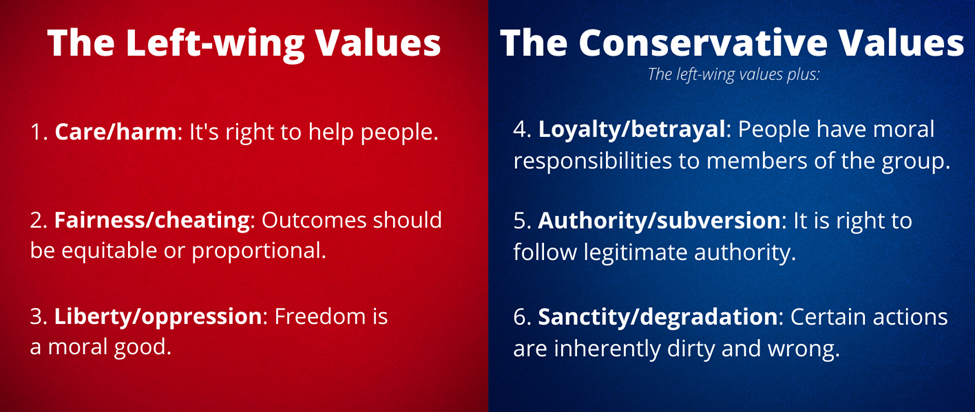
Unlike the tactical answer, this explanation can describe why flags were at the Convoy protest, but not at the BLM march. The key distinction is the ideological orientation of the two protesting groups. The Convoy was a right-leaning protest, while most demonstrators at the BLM protest were probably left-leaning. These two political identities are correlated with different moral compasses. On the left, there are three predominant values: Care, Liberty, and Fairness (see image below). On the right, conservatives hold six values, including Loyalty (i.e. people have special moral responsibilities to in-group members). The flag, as a sign of national identity, is closely related to the Loyalty value, so it is far more likely to appear at a right-wing rally.
Mixing of Values
But, wait a minute, didn’t I write last week that the Convoy was driven by the Liberty value? Why would a symbol of Loyalty take such a central role in the protest? Shouldn’t we expect to find the Gadsden flag instead?
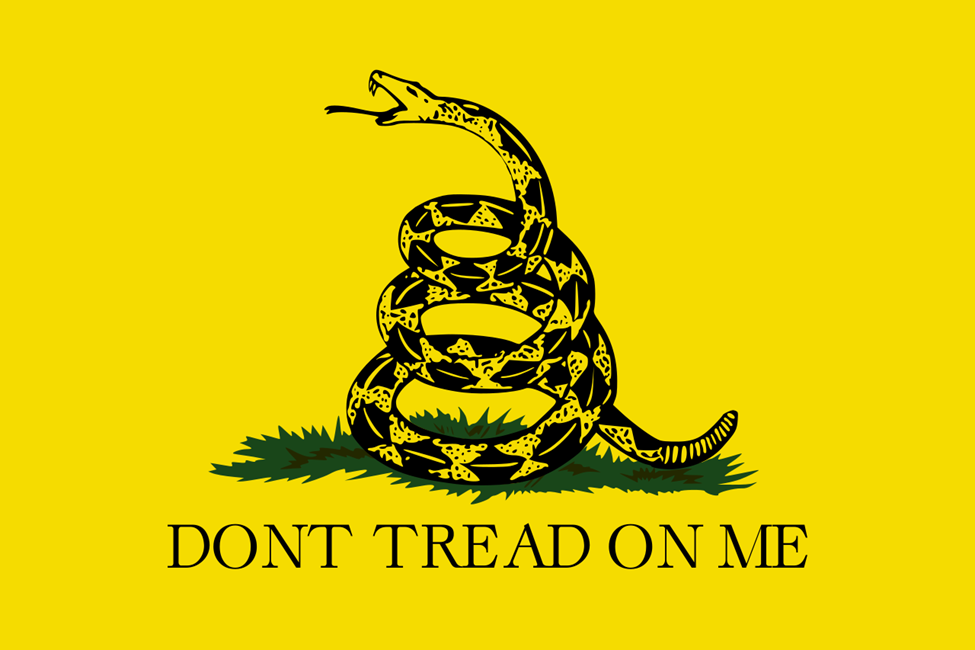
Well, we did, but the central prominence of the Canadian flag is an example of the mixing of values, and the resulting concoction can be extremely powerful. I had previously raised this point in my article on the Rude Tourist effect, which is the combination of the Loyalty value and the Authority value (i.e. followers should obey legitimate authorities, who should demonstrate effective leadership in turn). This mixture creates a strong moral force that causes us to judge poorly behaved tourists far more harshly than unruly locals. Both groups break the rules, which violates the Authority value, but only tourists can also be viewed as insulting our national group through their behavior.
The Convoy also mixed values, and its moral force was evident. Although the primary moral impetus was provided by the Liberty value, our brains don’t neatly separate out values like on this website. Events are either moral or not, and when people determine that a cause is justified, they will muster all their beliefs in order to defend it. As right-leaning individuals, the Loyalty value was still important to many of the protesters, so it was only natural that the two values would become conflated. To these people, the Convoy represented “real Canada”, so the display of the Canadian flag was a natural extension of their moral views. Even though the Convoy fought for freedom, it was also patriotic. In fact, it must also be patriotic. Actions aren’t moral and immoral at the same time, meaning that, according to the moral matrix of a right-leaning person, causes can’t be simultaneously pro-liberty and unpatriotic. It’s a contradiction of terms.
In contrast, the BLM protesters had no such impulse. Given that left-leaning folks don’t typically rely on the Loyalty value in their moral decision making, national flags were not an obvious or natural choice to be a symbol of their movement. Instead, they displayed placards featuring protest slogans that referred mainly to harm and injustice.
It’s not that BLM protesters are unpatriotic; they certainly feel the Loyalty value to some extent. If asked directly whether the BLM Protest was pro-Canada, the demonstrators would probably say that it was, perhaps while pointing out the country’s flaws. However, this value plays a secondary role in left-wing thought, so we wouldn’t expect to see flags at a left-wing protest.
Conclusion
Although I am skeptical that the Convoy employed the Canadian flag for tactical reasons, its use of the flag probably enhanced its longevity and appeal. The Convoy’s combination of two values makes it morally responsive, because it broadens the moral allure of the protest. Everyone has their own personal moral compass, which includes differing weightings of the six moral values. Although the Liberty value may be enough to get libertarians in the streets, some people feel the pull of Loyalty more strongly. By making a nationalist symbol a central element of the protest, more people are likely to find something attractive in the protest, get involved, and stay longer. Regardless of how you apprise the Convoy, everyone must admit that the protesters had plenty of dedication to their cause. This is in part due to the force of the moral values that underpinned the movement.