Vlad’s Values (Part 2)

As past Values Added articles have explained, there are six different values that people hold, and these values are key to understanding our worldviews:
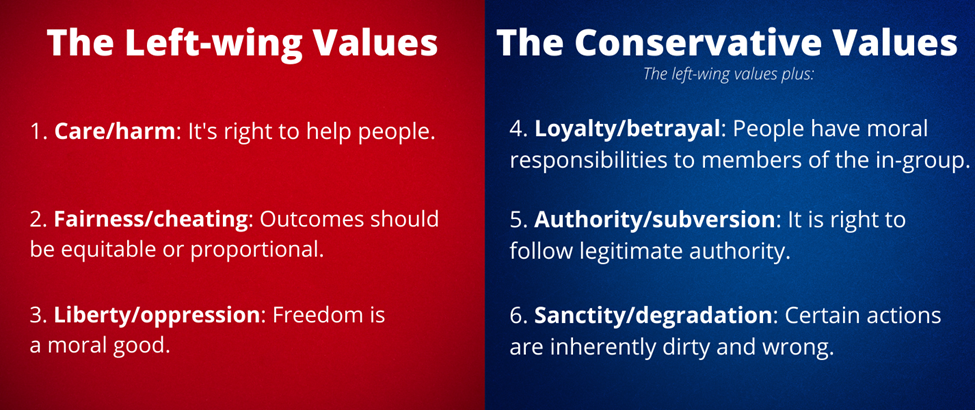
Although everyone holds all six values to some degree, people experience them in different ways. Some people believe that the care/harm value is the most important, but also feel the pull of the fairness/cheating and the liberty/oppression values. Others believe that all six are equally valuable. This is normal. In fact, our moral views can be roughly predicted by our membership in political groups. For example, libertarians tend to weigh the liberty/oppression value heavily, but care little for the loyalty/betrayal value. Although this is a fair generalization, it’s somewhat incorrect. Within every group, there remains significant diversity, as everyone has their own personal weighting of values as well.

Read more

Vlad’s Values (Part 1)

Over the past two weeks, I have argued that analysts should use a wider set of tools to understand international politics. The tools of structural analysis, such as comparisons of the wealth or military capabilities of different countries, are both useful and insufficient. At the end of the day, every government decision, from the introduction of a new housing policy to the invasion of another country, is made by people, so focusing exclusively on physical factors overlooks the psychological determinants of policy. As psychology and behavioral economics have made clear, people are not rational, so two people may view the same set of facts in completely different ways. Consequently, analysts should become familiar with the tools of psychological analysis, which outline how the thoughts and beliefs of world leaders can influence their decision-making.

One tool that could serve this purpose is values analysis. Although most Values Added articles have focused on the moral compasses of large groups of people (e.g. conservatives, libertarians), it may be possible to determine the values of a specific person if they have well documented views. I call this a moral portrait, as this term illustrates its personal nature. Long-serving world leaders, who have spent years giving speeches and enacting policy, are solid candidates for moral portraits, as analysts have a wealth of evidence available to draw conclusions from.

Read more

Moral Portraits: Explaining Individuals’ Behaviour with Values

Last week, I introduced two types of analysis: structural and psychological. The former is most commonly used in think tanks, academia, and government. It focuses on “real stuff” as much as possible, such as economies, armies, and institutions. There is a wide range of applications for structural analysis, including prediction and forecasting. When seeking to answer predictive questions (e.g. Will China invade Taiwan before 2023?), it is certainly helpful to look at subjects like relative wealth, military strength, and systems of governance. This can lead to important conclusions about the likelihood of an invasion occurring, which can inform our strategies for diplomacy, deterrence, and response.

However, as evidenced by the surprising decision of the Russian government to launch a full-scale invasion of Ukraine, structural analysis is not perfect. In this case, structural factors suggested that the costs of an attack would be extremely high for the Russian government, so a full invasion was viewed as unlikely. Instead, most analysts argued that a peaceful solution to the crisis or a limited incursion into Ukrainian territory was a more probable outcome. Clearly, this view turned out to be incorrect.

Read more

The Case for Psychological Analysis

The past several years have been filled with surprises. A reality TV star was elected to the highest office in the U.S., and he promptly upended decades of then-settled American foreign policy. A coronavirus, seemingly unremarkable at first, forced almost every country in the world to put their economies in stasis for months and fundamentally rethink their social contracts. The murder of a Black man by police in Minneapolis elicited worldwide demonstrations against racial injustice, despite similar events having been ignored or explained away for decades. I don’t know what is going to happen tomorrow, but I’m sure it will be unexpected.

Our most recent surprise was a big one: a continental war in Europe, something that many people had thought impossible in the 21st century. Big, interstate wars had gone out of fashion, and it was tempting to believe that the days of tanks rolling down debris-covered European streets were firmly in the past. Sure, the future could bring civil war (à la the former Yugoslavia) or limited military engagements (as occurred in Crimea in 2014), but it seemed possible that the norms against major war were strong enough to deter anyone from launching one. Unfortunately, this view turned out to be incorrect.

Read more