
I’m now going to demonstrate why values analysis (using the moral foundations “tool”) is useful for policymaking by looking at a news event: the Government of Alberta’s decision in late 2021 to provide a $100 incentive to newly vaccinated Albertans. Values analysis can help explain the controversy surrounding this decision in a systematic way.
Background
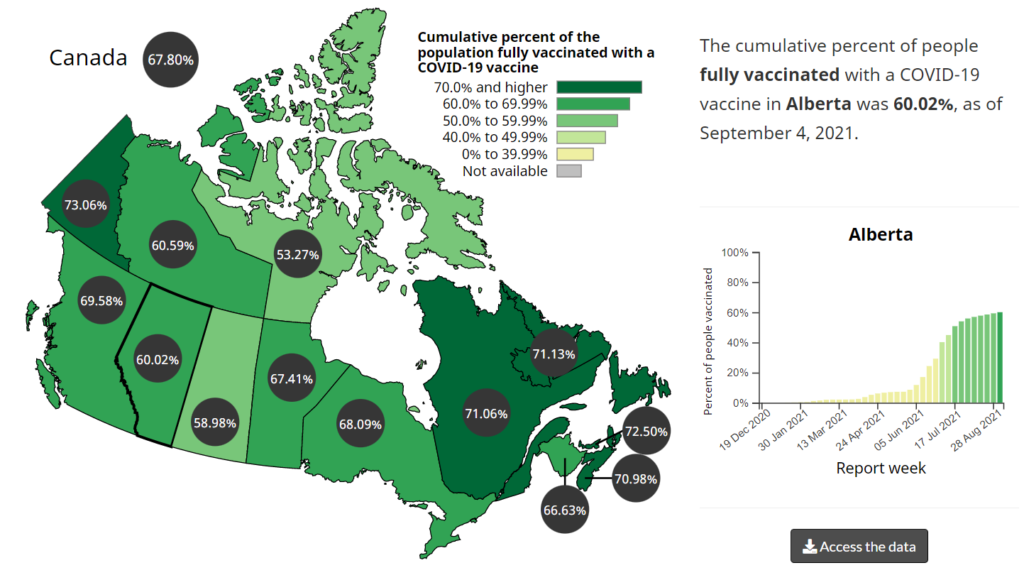
In early September 2021, COVID-19 cases in Alberta surged beyond 1000 per day, overwhelming hospitals and emergency rooms across the province. No doubt, this was related to Alberta’s relatively low vaccination rate. As of September 4, only about 60.2% of Albertans were fully vaccinated, ahead of only Saskatchewan (59%) and far behind Ontario (68.1%), Quebec (71%), and the Canadian leader Yukon Territory (73%). You go Yukon!
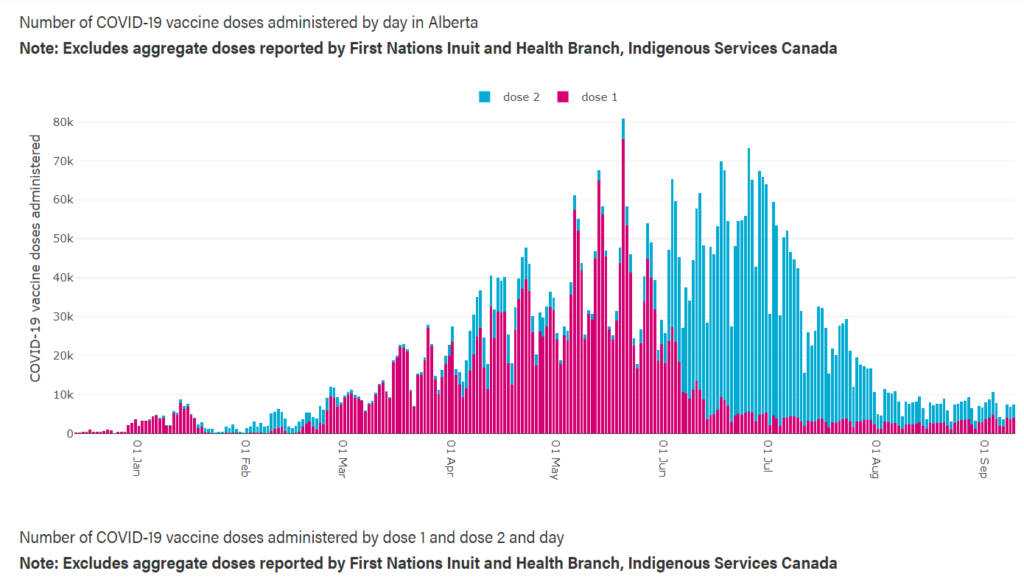
And it wasn’t like Alberta was catching up. If anything, it was falling further behind. Alberta was administering fewer than 10,000 doses per day, and only about 2500 of them were first doses, representing a new Albertan who decided to start the process. Despite already having a higher vaccination rate, Ontario was performing much better. It was delivering about 35,000 doses per day in September (3.5x higher than Alberta) with an unvaccinated population only about 2.5x larger. Simply put, Albertans have demonstrated a far higher rate of vaccine hesitancy than other Canadians, with the possible exception of Saskatchewanians (with all due respect, they need to rebrand their demonym).
Something needed to be done, and the Government of Alberta obliged with a unique incentive program: get jabbed, get $100. Although Premier Jason Kenney tried to get ahead of the blowback, noting that “this is not a time for moral judgments,” the backlash came all the same, and the policy quickly received the derisive nickname “Kenney’s Pennies” in some circles online.
The Policy Menu and the Operational Values
So, that’s what happened. Let’s apply what we learned about moral foundations theory by outlining four possible policies that the Government of Alberta could have implemented and analyzing the values that would be supported and violated under each policy.
Jason Kenney outlined the policy choice best in his announcement of the incentive: “If the choice is between a sustained crisis in our hospitals or, God forbid, widespread restrictions, which I want to avoid at all costs, or finding some way to get the attention of those vaccine latecomers, we’re going to choose the latter.” Of course, there was a fourth option that Premier Kenney didn’t mention: vaccine passports. Let’s tackle these one by one.
Policy Option 1: Do nothing
As Premier Kenney noted, letting the fourth wave run its course would stress hospitals and lead to more deaths. This is a violation of the Care value (i.e., causing pain is wrong, especially to the vulnerable), and it is by far the most saliant value at play.
So far, so obvious. However, another key value is also operational: Fairness (i.e. people should be treated in similar ways and/or people should get what they deserve). Interestingly, doing nothing to reduce COVID-19 infections both violates and harmonizes with the Fairness value. On one hand, an out-of-control fourth wave (caused primarily by the unvaccinated) is not fair to those who cannot get vaccinated due to pre-existing conditions. Their health will be put at risk by no fault of their own.
On the other hand, many people seem to get a perverse sense of satisfaction when the unvaccinated get their just deserts, even if that is their death. At the high of the pandemic, the left-leaning sub-Reddit the Herman Cain Award attracted nearly 300,000 subscribers, and it was growing extremely rapidly when the vaccine incentive was announced (about 50,000 new subscribers every week as of late September 2021). This online forum contained series of screen-capped social media posts from anti-vaxxers and COVID-skeptics. The first several posts usually included a series of pugilistic comments from an individual about how vaccination is dangerous and the pandemic is overblown. The final post in the set was the announcement of that person’s death or hospitalization from the disease. Schadenfreude ensued. Since it was designed to show how certain actions/beliefs lead to the “just” outcome, the Herman Cain Award sub-Reddit appears to be harmonizing with the Fairness value. As a result, we can conclude that allowing COVID-19 deaths to rise can be viewed as “fair” to a subset of the Canadian population.
I am not saying that the Herman Cain Award sub-Reddit is a good or a bad place. I am here to describe the reactions that people have, and how this relates to their values and public policy. You might think the celebration of death on display in these corners of the internet is immoral. You might also be an avid subscriber to this forum. I don’t care, and I’m not going to tell you what I think. My job is to outline the values that are operational, and not state whether I subscribe to those values.
To sum up Policy Option 1, doing nothing violates the Care value and both violates and harmonizes with the Fairness value.
Policy Option 2: New restrictions
Instituting a new lockdown is a proven public health solution to rising COVID-19 cases. This has a mixed effect on the Care value. Of course, fewer cases and deaths harmonizes with the value, but Albertan businesses would suffer under another set of restrictions. This also has a Fairness element: these businesses are not responsible for the fourth wave, so why should they pay the largest price by having to close their doors again, just as they are getting their financial houses in order?
New restrictions also violate a third value: Liberty (i.e., freedom and autonomy are moral goods). Anti-lockdown protesters often explicitly employ narratives about liberty and oppression to communicate their frustrations. Forcing people to stay home and businesses to close is viewed by many as an infringement on liberty. This appears to have been a tolerable cost in previous waves, but people everywhere have legitimate concerns about the government continuing to exert such forceful control over their ability to see friends, frequent businesses, and live as they see fit.
Policy Option 3: Vaccine Passports
Like the new restrictions option, the implementation of a vaccine passport system harmonizes with the Care value. The unvaccinated will have less ability to enter shared spaces, reducing their capacity to pass on the virus. This policy option also harmonizes with the Fairness value. Only individuals who refuse vaccination will experience restrictions, which clearly aligns actions and consequences.
However, this option has its drawbacks. The primary violation lies in the Liberty value. Although vaccine passports don’t go as far as universal mandatory vaccination (which no government supported), but they move in the same direction. Vaccine passports rely on negative incentives to encourage vaccination (e.g., No jab? No restaurant for you.) If the restrictions are strong enough that an unvaccinated person cannot fully partake in public life, it could amount to universal mandatory vaccination by softer means. Sure, government doctors won’t be busting down your door with a syringe in hand, but the daily friction of living the unvaccinated lifestyle could be too much to bear.
There is evidence that the Liberty value has been front-and-centre in Alberta’s response to COVID-19. Premier Kenney didn’t believe it was the government’s role of compel people to get vaccinated. As a result, the Government of Alberta resisted a government-mandated passport program for a long time. This reveals a strong adherence to the Liberty value within the Government of Alberta, and likely, within Albertan society writ large.
Policy Option 4: The $100 Giveaway (and other positive incentives)
This brings us to the most unusual policy: the distribution of a $100 pre-paid debit card to every Albertan who receives their first or second dose within a set period of time. If successful, this policy would have similar effects as another lockdown and vaccine restrictions. It would encourage more vaccination, reduce deaths, and harmonize with the Care value. Unlike vaccine passports, there would have been no violation of the Liberty value. The unvaccinated would remain able to take part in public life and would not be strong-armed into getting a vaccine.
Given this, you would think that the policy would have been positively (or at worst neutrally) received. But the opposite was true – there was a huge public outcry. If it could save lives, then why did this policy receive such a negative public reaction? Values analysis helps us answer this question. It is a major violation of the Fairness value. Under vaccine passports, slow adopters of the vaccine are punished, but under this policy, they are rewarded with the opportunity to get free cash. Responsible Albertans who rushed to get their vaccinations months earlier get nothing.
The outrage elicited by this violation of the Fairness value is clearly expressed in this letter to the Edmonton Sun, quoted in full:
Hey Jason Kenney, where’s my $100? I’ve been double vaccinated for months and now I’m looking forward to my cheque for being such a good citizen. Seriously, you are actually rewarding people for being late in the vaccination queue? I really don’t think most anti-vaxxers will stand in line to get a $100 reward for the jab, their high principles are worth more than a measly $100. I need a hundred good reasons to vote for you!
The thrust of the letter is firmly based in fairness, even if the author also questions the effectiveness of the policy.
Policy Summary
Here’s a summary table of the impacts on each value:
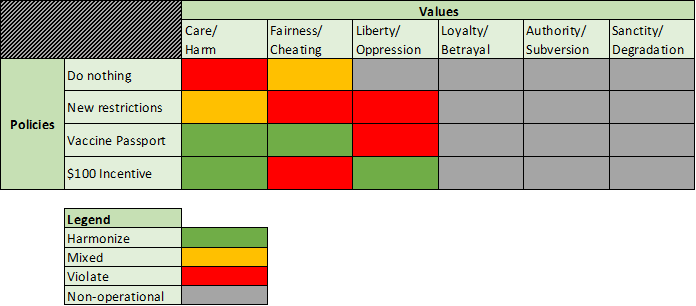
Note: when I say that Loyalty, Authority and Sanctity are not operational in this case, I mean that I have not found evidence of these values being central in the public’s assessment of the Government of Alberta’s policy. That does not mean they are not relevant to some Canadians in their level of vaccine hesitancy.
Based on this analysis, it doesn’t look like do nothing nor new restrictions are particularly attractive options from a values point of view, although they could be selected on other grounds (e.g., lower cost, ease of implementation, political risks). Values analysis is not the appropriate tool to explore these other considerations, so I’m not going to comment on these issues. For our purposes, the vaccine passport and the $100 incentive are equally optimal.
So What?
Of course, as a public servant, it’s not my place to decide between a $100 incentive and a vaccine passport. Only elected representatives have the mandate to choose. Even so, this sort of analysis is useful in two ways:
Better policy design: The goal of this analysis is to design policies that maximize value harmonization and minimize value violation. On the maximization front, the Care value would be maximized based on the effectiveness of the $100 incentive (i.e., how many people take up the offer). The public service already has all the tools necessary to improve policy effectiveness in the traditional sense (e.g., communications strategies, needs-testing, etc.). Value analysis doesn’t add much to this conversation. On the Liberty value, the $100 incentive is naturally designed to maximize liberty, so this is also unlikely to be a particularly profitable area to improve the policy. Overall, it seems like the values are already suitably maximized by the $100 incentive program, although there is always room for improvement.
The policy may still be perfected by minimizing the violation of the Fairness value, however. One promising avenue would be to give the incentive to everyone who was vaccinated, regardless of when they received their jab. This approach would certainly cost more, but the policy would then harmonize with the Fairness value rather than violate it, because only vaccinated people get $100 as a reward for their responsible behaviour. The unvaccinated get nothing. For implementation, vaccinated Albertans could receive their incentive with the proof-of-vaccination card that the Government of Alberta always intended to distribute. Further, perhaps the $100 incentive could only be used at local restaurants, which would further maximize the Care value (those who were most harmed economically by the pandemic receive the benefit).
Of course, I wasn’t around the Cabinet table when this policy was announced, and maybe these options were considered and rejected for various reasons (perhaps on cost or speed of implementation). I also strongly doubt that I am the first person to suggest distributing the $100 to all vaccinated Albertans. However, value analysis gave me a frame to find these other possibilities, some of which might work better. This is what policy tools are designed to do.
Better advice: For argument’s sake, let’s just say that the design of the four options was optimized, and one value couldn’t be further maximized without negatively affecting another. Even here, values analysis serves an important function: it illuminates the value determinations that the elected representatives are expected to make. Without this systematic approach, elected representatives are guided exclusively by their moral intuitions. This can lead to errors in thinking and judgement. Perhaps the Government of Alberta didn’t realize the extent in which they were favouring the Liberty value over the Fairness value in selecting the $100 incentive over the vaccine passport. Although Premier Kenney’s previous comments suggest the Government was aware of how the incentive would be perceived, it is always preferable to make an implicit decision explicit. This is much simpler to do with a clear framework, like the one above.
Conclusion
Of course, this story didn’t end here: the $100 incentive didn’t raise vaccination rates, and the Government of Alberta then announced its intention to implement vaccine passports, as it had “run out of options.” It’s likely that the incentive was a last-ditch effort to avoid such an outcome. At first glance, a $100 incentive is a low-cost, low-risk measure that might work just well enough to make vaccine passports unnecessary, and government has the responsibility to assess a wide range of policy options before implementing more drastic measures. Why not give it a try?
However, values analysis shows that the $100 incentive cost much more than a few dollars. The violation of values is not free; it costs political capital (and sometimes a lot of it). This tool helps illuminate these hidden costs.
If you liked this article, please consider signing up for the mailing list on the right side of this page. A new article will be sent second Tuesday at 9:00 AM.
Great real life example of the theory expressed in the first two posts. I look forward to reading about more policy examples. Thanks.
Great article! Looking forward to reading more. As you mentioned in previous articles, the Vues anysis provides another cost dimension that the standard analysis lacks. I wonder, if there are examples where a values analysis can suggest policy options that are different than policy options presented through standard socioeconomic, Care/Harm, or econometric analysis.
Thanks Manas! There are ways that values analysis can lead to new policy options. I’ll give an example in three weeks.