Vlad’s Values (Part 2)

As past Values Added articles have explained, there are six different values that people hold, and these values are key to understanding our worldviews:
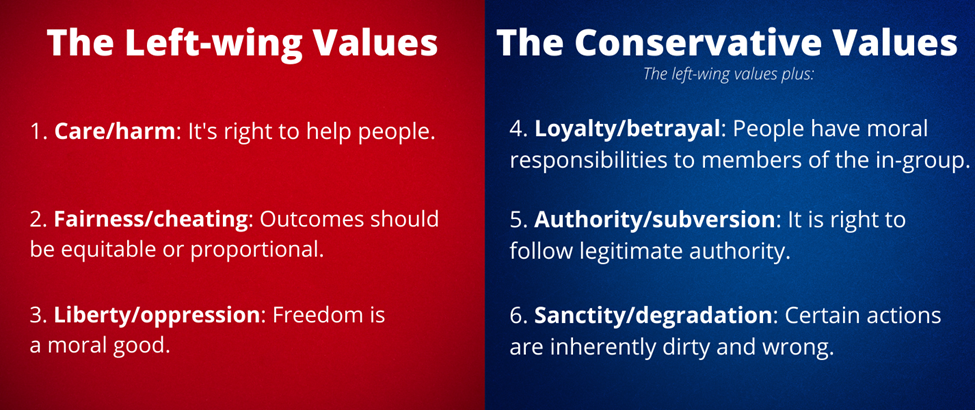
Although everyone holds all six values to some degree, people experience them in different ways. Some people believe that the care/harm value is the most important, but also feel the pull of the fairness/cheating and the liberty/oppression values. Others believe that all six are equally valuable. This is normal. In fact, our moral views can be roughly predicted by our membership in political groups. For example, libertarians tend to weigh the liberty/oppression value heavily, but care little for the loyalty/betrayal value. Although this is a fair generalization, it’s somewhat incorrect. Within every group, there remains significant diversity, as everyone has their own personal weighting of values as well.

Read more

Vlad’s Values (Part 1)

Over the past two weeks, I have argued that analysts should use a wider set of tools to understand international politics. The tools of structural analysis, such as comparisons of the wealth or military capabilities of different countries, are both useful and insufficient. At the end of the day, every government decision, from the introduction of a new housing policy to the invasion of another country, is made by people, so focusing exclusively on physical factors overlooks the psychological determinants of policy. As psychology and behavioral economics have made clear, people are not rational, so two people may view the same set of facts in completely different ways. Consequently, analysts should become familiar with the tools of psychological analysis, which outline how the thoughts and beliefs of world leaders can influence their decision-making.

One tool that could serve this purpose is values analysis. Although most Values Added articles have focused on the moral compasses of large groups of people (e.g. conservatives, libertarians), it may be possible to determine the values of a specific person if they have well documented views. I call this a moral portrait, as this term illustrates its personal nature. Long-serving world leaders, who have spent years giving speeches and enacting policy, are solid candidates for moral portraits, as analysts have a wealth of evidence available to draw conclusions from.

Read more

Moral Portraits: Explaining Individuals’ Behaviour with Values

Last week, I introduced two types of analysis: structural and psychological. The former is most commonly used in think tanks, academia, and government. It focuses on “real stuff” as much as possible, such as economies, armies, and institutions. There is a wide range of applications for structural analysis, including prediction and forecasting. When seeking to answer predictive questions (e.g. Will China invade Taiwan before 2023?), it is certainly helpful to look at subjects like relative wealth, military strength, and systems of governance. This can lead to important conclusions about the likelihood of an invasion occurring, which can inform our strategies for diplomacy, deterrence, and response.

However, as evidenced by the surprising decision of the Russian government to launch a full-scale invasion of Ukraine, structural analysis is not perfect. In this case, structural factors suggested that the costs of an attack would be extremely high for the Russian government, so a full invasion was viewed as unlikely. Instead, most analysts argued that a peaceful solution to the crisis or a limited incursion into Ukrainian territory was a more probable outcome. Clearly, this view turned out to be incorrect.

Read more

The Case for Psychological Analysis

The past several years have been filled with surprises. A reality TV star was elected to the highest office in the U.S., and he promptly upended decades of then-settled American foreign policy. A coronavirus, seemingly unremarkable at first, forced almost every country in the world to put their economies in stasis for months and fundamentally rethink their social contracts. The murder of a Black man by police in Minneapolis elicited worldwide demonstrations against racial injustice, despite similar events having been ignored or explained away for decades. I don’t know what is going to happen tomorrow, but I’m sure it will be unexpected.

Our most recent surprise was a big one: a continental war in Europe, something that many people had thought impossible in the 21st century. Big, interstate wars had gone out of fashion, and it was tempting to believe that the days of tanks rolling down debris-covered European streets were firmly in the past. Sure, the future could bring civil war (à la the former Yugoslavia) or limited military engagements (as occurred in Crimea in 2014), but it seemed possible that the norms against major war were strong enough to deter anyone from launching one. Unfortunately, this view turned out to be incorrect.

Read more

Being Morally Responsive: The Correct Design and Implementation

Over the past two weeks, I have published a guide to implementing values analysis in the policy development process. The first article was about the correct mindset, outlining how analysts need to think about moral values to make the tool work. Without this way of thinking, values analysis is more likely to simply confirm preexisting biases rather than help public servants explore alternative ways of viewing the world. In other words, the tool would be useless, and maybe even counterproductive, which means that this mindset is a critical part of values analysis that cannot be ignored.

Next, I outlined the proper research method for values analysis. It is firmly rooted in the material world, drawing on the views of real people. Good research in this space is focused on what morality is, not what it ought to be. Key sources for this research, such as social media posts and the oft-dreaded comment section of news articles, are frequently ignored, because they are deemed to be too emotional and irrational. However, for the purposes of values analysis, this is feature, not a bug. They show what people think, and the job of the public servant is to take this into consideration to make better policy.

Read more

Being Morally Responsive: The Correct Research Method

Last week, I outlined the correct mindset for values analysis. Fundamentally, it’s optimistic and gives people the benefit of the doubt, not because this view necessarily describes human behaviour (although I think it does), but because it is more useful for analysts to think this way. The values analysis mindset combats groupthink, leads to stronger analysis, and more effectively challenges assumptions. So, before we continue, let’s get into this frame of mind by repeating after me…

People generally say what they believe…

Good people can have different moral compasses…

Finding the lowest possible explanation for a belief doesn’t mean you’ve found the correct one…

Read more

Being Morally Responsive: The Correct Mindset

In this first article on the art of being morally responsive, I’d like to focus on what happens between your ears. Every policy tool (e.g. gender-based analysis, risk management) has a set of check-lists, matrixes, and processes that need to be used. These are both important and insufficient; a policy tool also has an associated mindset that practitioners need to understand and apply. Without the right way of thinking, the tool won’t work.

For example, in a cost-benefit analysis, it’s best to think exclusively in financial terms by attempting to put a dollar value on everything. This includes assets and liabilities that are easily appraised (like the cost of purchasing materials or financial savings), but also intangibles when possible. In extreme applications of this mindset, economists have even estimated the value of a human life using statistical methods. Although unpalatable for many people, this estimate can be a useful way to compare the costs and benefits of a particular policy. As a hypothetical, imagine that building a traffic barrier would cost $10 million and would be expected to save one life. If a human life is “worth” $11 million, then this is a sound investment (ignoring discount rates). If it is only worth $9 million, then it’s not, and the money should be spent elsewhere, even if we know that someone will die as a result. This is a cold, calculating, and sometimes disconcerting way to make decisions, one that we would expect robots to use. But it has to be this way. Without translating everything into the same “units” (e.g. dollars), comparisons are difficult and cost-benefit analysis can’t be done very effectively.

Read more

Moral Responsiveness

Values Added has been up for six months now, and I’d like to take some time to sum up some of the lessons that we can draw from past articles. One phrase that I have often used is moral responsiveness, which is the end goal of values analysis. Broadly defined, a morally responsive policy aims to minimize the violation of values to reduce backlash, and maximize the harmonization of values to garner public support. In developing morally responsive policies, public servants need to give a full hearing to a broad range of moral compasses and make appropriate adjustments, such as altering the design of the policy to make it more acceptable, honing the communications strategy to mobilize support, or even just providing better information to decision makers.

Keep in mind, a morally responsive policy does not need to align with all moral compasses. That’s not possible or even desirable. For example, a left-leaning government does not need to implement socially conservative policies just because some people would be outraged if they didn’t. Nor does a left-leaning government need to believe that socially conservative policies are justified or right. That’s not moral responsiveness; that’s moral agnosticism. Elected governments need to choose between values. It’s their job.

Read more

The Trolley Problem

If you’ve ever taken Philosophy 101 at university or had the misfortune of sitting next to a self-proclaimed philosopher at a party, you’ve probably heard of the Trolley Problem:

There is a runaway trolley barreling down the railway tracks. Ahead, on the tracks, there are five people tied up and unable to move. The trolley is headed straight for them. You are standing some distance off in the train yard, next to a lever. If you pull this lever, the trolley will switch to a different set of tracks. However, you notice that there is one person on the sidetrack. You have two (and only two) options:

  1. Do nothing, in which case the trolley will kill the five people on the main track.
  2. Pull the lever, diverting the trolley onto the sidetrack where it will kill one person.

Which is the more ethical option? Or, more simply: What is the right thing to do?

It’s a classic of ethics, and an untold number of hours have been spent trying to sort out the moral implications of this hypothetical situation. Many of you have probably seen this TED talk on the subject, which was one the truly great videos that rocketed TED into the mainstream – before it got bogged down in this TED X nonsense where hand drying techniques are apparently worth our attention. There’s even a whole book devoted to the subject (the Trolley Problem, not hand drying).

Read more

Flags and Protests

Last week, I opened a discussion on the Freedom Convoy that occupied Ottawa and blockaded key international crossings for weeks. The Convoy was supported by a range of groups, some respectable and some abominable. I chose only to discuss the views of the more constructive groups, and I left the neo-Nazis, the thugs, and the white supremacists to be handled by writers elsewhere. Since values analysis is about understanding and accounting for people who hold different moral compasses, it is necessary to distinguish between the various sub-groups in a broad movement and to be explicit about the sub-groups under examination. Individuals hold a diverse range of values, and it is critical to make fair distinctions within movements when warranted. If this process of sifting is not undertaken properly, values analysis becomes an exercise creating strawmen, rather than truly accounting for moral preferences. In other words, it becomes useless.

With that said, my previous article outlined how Convoy was given moral force by the Liberty value (i.e. i.e. freedom and autonomy are moral goods). In short, the public health measures implemented to address the COVID-19 pandemic have repeatedly violated this value, as Canadians were forced to accept restrictions on their freedoms of movement that would have been unthinkable in the “Before Times.” For the first two years, people believed that the restrictions were morally justified, but this consensus has collapsed. A significant proportion of the Convoy was made up of individuals who value the Liberty value most, and they are most willing to protest (and to be arrested) for it.

Read more