
Last week, I outlined the correct mindset for values analysis. Fundamentally, it’s optimistic and gives people the benefit of the doubt, not because this view necessarily describes human behaviour (although I think it does), but because it is more useful for analysts to think this way. The values analysis mindset combats groupthink, leads to stronger analysis, and more effectively challenges assumptions. So, before we continue, let’s get into this frame of mind by repeating after me…
People generally say what they believe…
Good people can have different moral compasses…
Finding the lowest possible explanation for a belief doesn’t mean you’ve found the correct one…

And there we go; we’re in the zone. But now what? Values analysis isn’t just a way of thinking. It’s a rigorous method for systematically exploring moral reactions to improve policy, and “rigor” cannot be achieved without an effective research method. Evidence is a critical part of values analysis, and in collecting it, keep these three points in mind:
1. Avoid exclusively theoretical assessments when possible.
If you’ve studied philosophy in university, words like utilitarianism and deontological ethics might mean something to you. These schools of ethics are foundational to the academic study of values. Utilitarianism, which posits that the morally right action brings the greatest happiness (or utility) to the greatest number of people, seems convincing to many people. Causing harm in aggregate must be wrong, right? But deontological ethics, which instead focuses on intentions as the most important factor in determining morality, can also seem correct in certain situations. If a righteous person causes harm by sheer bad luck, is it fair to judge this person as immoral? Wouldn’t it be better to focus on their intentions in this case? Of course, other philosophers subscribe to dozens of other schools, all of which characterize ethics through other lenses.
Although interesting, policy analysts should not base their work on any of these ideas. Philosophy is about the application of reason. But morality, for better or worse, does not appear to be rooted in rationality; it’s driven by our emotions and intuitions. This explains why many brilliant people have spilled so much ink over ethics with little to show for it, besides some elegant theories that collapse at first contact with real human behaviour. Since policy analysts need to operate firmly in the real world, this isn’t going to cut it.

So, let’s not bother theorizing about what Aquinas, Kant, or Bentham would say about a particular policy problem or developing models about what morality should be. Instead, let’s just focus on what real people believe, and go from there. It won’t align with philosophical theories most of the time, but that’s fine.
Now, I use a specific theory on this blog that derives from psychology: moral foundations theory, which posits that there are six fundamental values that we all hold to varying degrees. This theory differs from the philosophical schools in that it only seeks to describe moral beliefs as held by people, rather than to develop a bulletproof rational model for the “correct” moral code. It was created based on observations of real behaviour, not academic theorizing. Although the authors of the theory have spent time exploring their evolutionary roots, the six values don’t need to be explained. They can just exist.
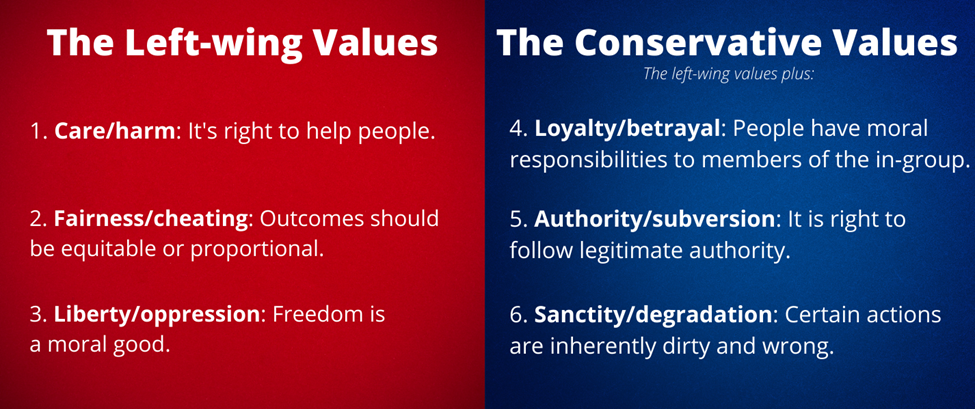
Obviously, I think moral foundations theory is basically accurate, but it isn’t sufficient alone. Analysts can’t just understand it, think about the policy problem, predict how people will react, and inform decision-makers. That’s not enough, as there’s a considerable uncertainty about real human behaviour. Moral foundations theory may predict a particular reaction, but that’s still just a hypothesis until evidence is collected and analyzed.
2. Use evidence about real people’s views. This should include data from social media posts and polls.
Thirty years ago, values analysis would have been difficult to implement, as data on people’s thoughts was hard to find. Sure, there were phone polls, but they were relatively rare and expensive. As well, they usually focused on specific political questions (i.e. Do you support private or public schooling?), without much effort devoted to asking why. The same view could flow from relatively technocratic considerations (e.g. I oppose private schooling because I read a study that showed it is ineffective) or moral considerations (e.g. I oppose private schooling because it’s wrong to have a separate system of education for rich people). As a result, values analysis would be difficult to apply, as it would be impossible to focus in exclusively on moral views.
How much has changed in the 21st century! Now, we live in a hyper-connected world, where the necessary information to enable values analysis is easily available. Not only is polling conducted much more frequently and cheaply, but social media also generates thousands of pieces of evidence every day. Times have changed, and values analysis can be performed by anyone with an Internet connection.
Unfortunately, there’s a common view that social media (and the comments section on news articles) is a cesspool of idiocy, high in emotion and low in critical thinking. As a result, analysts don’t tend to take social media seriously as a source of policy research. Although this may be true if you’re looking to debate the finer points of political theory, it’s false if you simply want to learn about people’s emotions. And that’s exactly what values analysis is designed to do: dig into moral reactions that come from the gut, not the brain. So, social media is the first place to go to find good evidence for values analysis.
It’s best to find sources that have a voting mechanism, so that it’s clear if a post or a comment is just the ramblings of one person or the views of a considerable subset of the population. For this reason, I rely heavily on Reddit and the most highly rated comments on news sites (e.g. the Globe and Mail). As well, when conducting values analysis, it’s not a bad idea to see what partisan sites are “reporting” (e.g. Breitbart, Jacobin). The specific content of their articles is probably false or misleading, but it usually aligns with people’s moral intuitions. The moral force of these sites is often the source of their popularity, so they can provide clues about how people are reacting to policies and other government actions.
3. Don’t expect people to be perfectly consistent. None of us are, and that’s okay.
People usually believe that their moral views are rock-solid and unwavering. This is nonsense – most people are all over the place, flip-flopping based on the specifics of the situation. Classic hypotheticals in philosophical ethics, such as the Trolley Problem, clearly demonstrate that people’s moral views are wildly inconsistent.

It’s fair to say that that moral hypocrisy is a normal part of being human. Well-meaning people can take one position in one specific context, and the opposite view in another. For example, when MP Pierre Poilievre was advocating for more forceful action to bring an end to the 2020 Rail Blockades, he argued that it was a moral responsibility of the government to intervene, as the protesters were taking away the freedoms of other Canadians. However, in response to the 2022 Freedom Convoy that gridlocked downtown Ottawa for weeks, MP Poilievre took the complete opposite stance, supporting the Convoy and becoming one of its most high-profile supporters. Any neutral observer would note that the two situations are extremely similar, leading to charges of hypocrisy and political cynicism.
That might be a fair assessment (I’m not here to judge), but MP Poilievre’s seeming inconsistency was, in the grand scheme of things, normal. Even though the two situations were similar, they were not identical. Since our moral reactions can change completely based on minor factors, it’s unsurprising that MP Poilievre reacted differently to the 2020 Rail Blockades and the 2022 Freedom Convoy. His inconsistency is not bulletproof evidence of political opportunism, because people are flexible in questions of morality, and it’s silly to pretend otherwise.
For the policy analyst, our inconsistency is both an opportunity and a risk. It is an opportunity because minor adjustments to a policy could elicit widely different moral reactions, giving analysts considerable power to shape public reactions with only minor adjustments. However, it is also a risk because past events can only ever serve as rough guides to the future. The clever analyst may have anticipated that right-wing leaders would oppose the Freedom Convoy based on their reactions to the Rail Blockades. But that’s not what happened, so it is important for analysts to be sufficiently humble in their assessments and to explore every issue from several angles.
Conclusion
To provide accurate advice on the confluence of values and policy, analysts need to follow the proper research method for values analysis. This approach has a theoretical component (which values are likely to be operational in this policy space?) and an evidentiary one (what are people saying about this issue? How does that relate to the six values?). On the other hand, analysts can’t assume that people will be perfectly consistent, as such an assumption does not reflect reality. Properly applied, values analysis stands to improve policy, so it is worth our time to experiment with this research method.