
As mentioned in my exploration of moral foundations theory, there are six moral values that people feel. But everyone doesn’t weigh every value equally. Some people may believe the Care value is the most important, but others may disagree. If you’re interested in learning about your values, I recommend taking the Your Morals online survey, which has been completed by hundreds of thousands of people to support research. It’s like a personality test; it’s fun!
Studies like this have led to important scientific findings. Most prominently, political views have been found to be correlated with different sets of moral values. So far, three “moral palettes” – different weightings of the six values – have been tracked:
The Liberal/left-wing Moral Matrix

To the political left, the Care value (i.e. causing pain is wrong, especially to the vulnerable) is the primary moral principle. Liberals (to use the American term) are interested in protecting victims, but they also defer to the Liberty value (i.e. freedom and autonomy are moral goods) when possible. It’s not uncommon for the political left to struggle when these two values contradict. For example, it’s conceivable that government surveillance programs would protect people from crime and terrorism, but such efforts would undermine the Liberty value as well. It’s difficult for the left to decide on the moral path forward in these cases.
The Conservative Moral Matrix
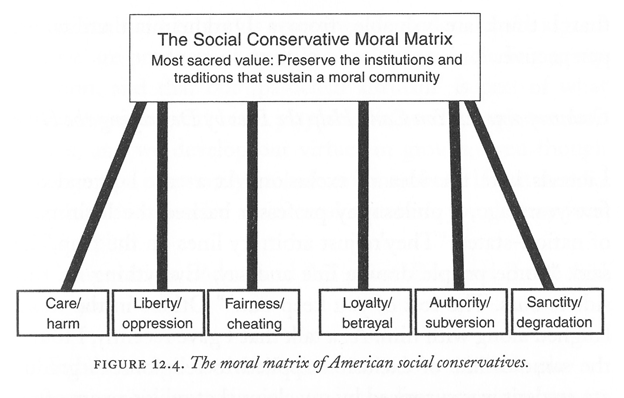
Unlike the political left, which has a central moral value, conservatives hold balanced moral palettes. All six values are weighted relatively equally. As a result, although conservatives believe protecting victims is important, they are willing to trade off the Care value for other moral goods, such as a stronger nation, deference to legitimate authority, or societal purity. Unfortunately for the quality of public debates about morality, the political left rarely views these goods as valuable. As a result, liberals and conservatives often talk past one another in questions of values. One side believes they are making a bulletproof moral argument, but it is unpersuasive to the other side.
Libertarian Moral Matrix
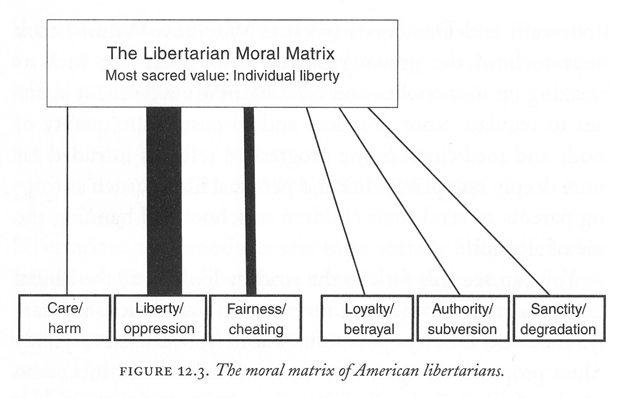
Libertarians are the easiest to understand: they like the Liberty value, and the Fairness value. Everything else is secondary. The political left can be baffled by Libertarians relative indifference to suffering, while conservatives struggle to understand their views on nationalism and authority. But this is how libertarians think, and they are a highly influential political movement.
Why Should the Public Service Care?
Although interesting, the average public servant may think this type of analysis is best left to the Prime Minister’s Office. The public service is non-partisan and non-political, so we don’t usually predict how citizens are likely to react to our policies based on their political alignment. That’s the job of political staffers.
However, the unavoidable biases of public servants make this a dangerous approach. Public servants tend to lean left and hold the associated moral matrix. This isn’t a failure of our non-partisanship; it’s primarily the result of demographic factors. Public servants are, on average, more educated, more urban, and younger than the average Canadian voter, all factors that have been correlated with more left-wing beliefs.
I don’t want to support the narrative that the public service is a “deep state” that undermines the conservative agenda (an idea that gets plenty of airtime in the media, such as here and here). In fact, Canadian public servants are adept at leaving their political views at the door and implementing the agenda of the governing party, regardless of their political leanings.
But we can’t pretend that we don’t have personal biases. Do we not have opinions? How could we not be biased in some way?
It’s vital for public servants to explicitly check their biases, because they can lead to sub-optimal outcomes. When serving a Government that holds the liberal moral matrix, the values of public servants broadly align with those of the Government, so our blind spots easily go unnoticed and unaddressed. As a result, the Government risks implementing controversial policies and misreading the reaction from major subsets of the population, which operate according to a different matrix.
The stakes are higher for the public service when a conservative (note the small “c”) or libertarian Government is in power. The public service’s focus on the Care value may seem out of touch when the Government is drawing on a broader range of values to make their decisions.
For example, let’s consider needle exchange programs, which provide likely drug users with clean syringes to facilitate safer drug consumption. These initiatives tend to be highly contentious. Many liberals believe needle exchanges programs are morally necessary because they reduce harm to drug users. Liberals rarely (if ever) encourage drug use, but if people are going to use narcotics, the government should make the practice as safe as possible.
Liberals have plenty of data on their side. The evidence suggests that needle exchange programs are cost-effective harm reduction strategies that can limit the spread of disease, deaths by overdose, and even public disorder. On Care grounds, the debate is settled, so I would expect the public service to broadly support needle exchange programs advice.
But Care is not the only value that people hold. A survey of over 5,000 U.S. citizens suggests that opposition to needle exchange programs is primarily rooted in the Sanctity value (i.e., certain actions are inherently dirty and polluting), which is more strongly associated with conservatives. To opponents, the injection of drugs is wrong, not only because of the damage narcotics cause, but because drugs are morally unclean. Drug use is an act of body pollution, leading to moral contamination in users and prompting strong feelings of disgust among those with high fidelity to the Sanctity value. As a result, the government should not facilitate drug use, even if doing so would reduce harm.
Consequently, simply listing the public health benefits (as the prototypical public service would do) is unlikely to convince a conservative government (or citizen) to support needle exchange programs. From such a government’s perspective, a moral government cannot facilitate drug use; doing so is a contradiction of terms. So, when the dutiful public servant goes to the briefing with the Minister and lists off peer-reviewed research that shows the harm-reduction potential of needle exchange programs, a conservative Minister’s reaction is likely to be negative: these overeducated wonks have lost their basic understanding of right and wrong. The briefing is unlikely to go well, and the Government may be less likely to heed out-of-touch advice from the public service in future.
Of course, this doesn’t mean that the public service shouldn’t make Care-based arguments to a conservative or libertarian Government. After all, the moral matrixes show that the Care value holds weight for everyone. As well, this doesn’t mean public servants should completely change their advice based on the moral preferences of the Government in power. However, the public service is likely to be more effective if it takes various values into consideration. In other words, the Care analysis is not inherently incorrect – rather, it’s incomplete.
Instead of neglecting the moral dilemma, it’s far more useful to address it immediately by saying, “I understand that it might seem wrong to support needle exchange programs because drug use can be viewed as inherently wrong, but our analysis shows that it would save so many lives that it would be worth it.” Taking conservative values into account can only improve the public service’s advice and communications, even when the chosen policy violates those values.
If you liked this article, please consider signing up for the mailing list on the right side of this page. A new article will be sent every second Tuesday at 9:00 AM.