
The past several years have been filled with surprises. A reality TV star was elected to the highest office in the U.S., and he promptly upended decades of then-settled American foreign policy. A coronavirus, seemingly unremarkable at first, forced almost every country in the world to put their economies in stasis for months and fundamentally rethink their social contracts. The murder of a Black man by police in Minneapolis elicited worldwide demonstrations against racial injustice, despite similar events having been ignored or explained away for decades. I don’t know what is going to happen tomorrow, but I’m sure it will be unexpected.
Our most recent surprise was a big one: a continental war in Europe, something that many people had thought impossible in the 21st century. Big, interstate wars had gone out of fashion, and it was tempting to believe that the days of tanks rolling down debris-covered European streets were firmly in the past. Sure, the future could bring civil war (à la the former Yugoslavia) or limited military engagements (as occurred in Crimea in 2014), but it seemed possible that the norms against major war were strong enough to deter anyone from launching one. Unfortunately, this view turned out to be incorrect.
Now, I don’t want to overplay this case, as I’m not here to attack strawmen. Plenty of very smart people were warning that a major invasion of Ukraine was possible, and some went as far to argue it was likely. Nothing is more annoying than the commentator who – with the full benefit of hindsight, complete information, and the knowledge of exactly what ended up happening – comes along and declares that the entire expert consensus was wrong, naïve, and misguided. No intelligence analyst worth their salary would have said that there was a 0% chance of a full-scale Russian invasion of Ukraine when 180,000 Russian troops were stationed on the border in December.
At the same time though, in the days leading up to the invasion, the smart money was on a peaceful solution to the dispute or at worst a limited incursion by Russian forces into eastern Ukraine. Don’t take my word for it though; look to the markets. In early February 2022, analysts at Amundi, the largest asset manager in Europe, forecast a 60% chance that there would be a peaceful resolution and a 30% chance of a limited incursion. A full-scale invasion was only 10% likely. Even as late as mid-February 2022, Metaculus, an (admittedly small) crowd-sourced prediction website, was projecting a sub-50% chance of any Russian invasion of Ukraine in 2022, limited or otherwise. Currency markets showed similar positivity, as many institutional investors bought low on the Russian ruble and the Ukrainian hryvnia in mid-February. People were putting their money down, and a major war was determined to be unlikely.
Structural Analysis
This optimism didn’t result from stupidity. Rather, it flowed from the use of rigorous analytical tools. This included economic analysis, which tended to focus on the immense price that Russia’s economy would pay if an invasion occurred. Since war would cause the Russian economy to collapse and, critically, undermine the position of the oligarchs who prop up President Putin’s regime, a full invasion was expected to be unlikely.
Other analysts focused on past policies, which in this case meant the Russian strategy of “hybrid war.” Although this term has turned into a rhetorical hydra that means something different to everyone, it’s commonly understood to apply to Russia’s attempts to destabilize Ukraine through any method short of war. It might be best called “Goldilocks War”; just enough to cause trouble, but not enough to elicit a massive response. This policy appeared to be successful to many observers, so why would the Russian government change its approach now?
Of course, no analysis of international conflict would be complete without mentioning the ‘national interest’, a frustratingly nebulous concept beloved by realists. Through this lens, countries pursue their goals, sometimes through war – famously described by Clausewitz as “the continuation of policy with other means.” There was a healthy debate before the invasion about whether such a move was in Russia’s national interest, and a convincing case could be made that the status quo (i.e. low-scale conflict in the Donbas, possibly via hybrid warfare) was the best case scenario for the Russian government. The costs of a full invasion to Russia would be high, as every nearby country would recalculate their security arrangements, potentially pushing many countries into the arms of the West. Some commentators claimed that Russia’s sabre-rattling in early 2022 was just meant to expose divisions within the West, knock the Ukrainian government off balance, pocket a few concessions, and end there. That would almost certainly be in Russia’s national interest, so it seemed reasonable to expect this to occur.
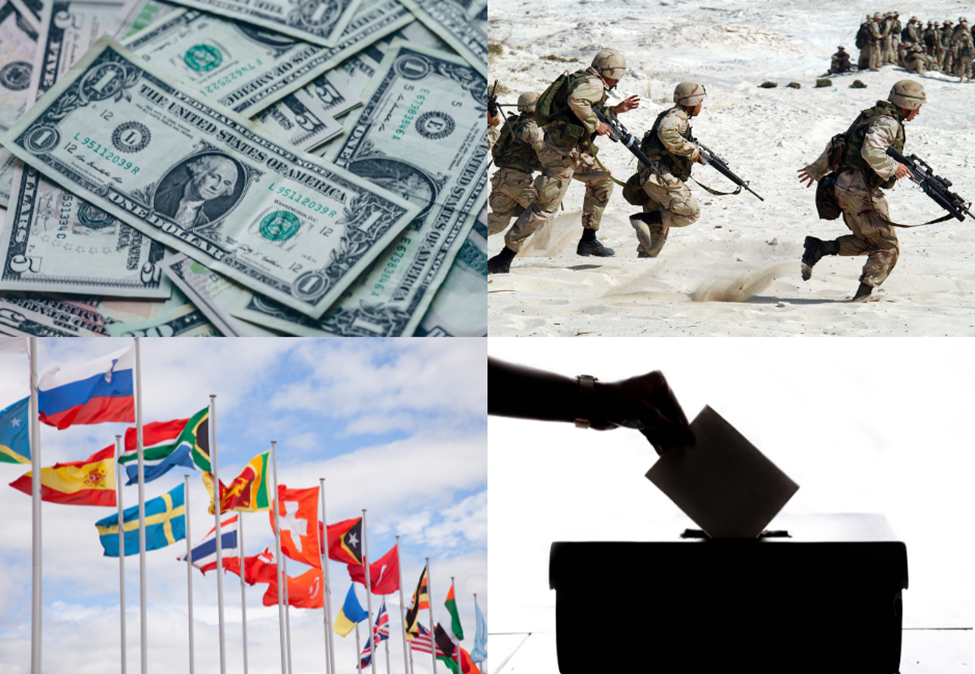
For the sake of this article, I’ll call these analytical tools “structural analysis”, because they focus on the structural determinants of policy. Beyond economics, past successes, and the national interest, other subjects could fall under the umbrella, including the institutions of the government, the relative strength of opposing armies, and national histories. The unit of account of structural analysis is usually the country, the government, or other institutions, sometimes described if they act on their own volition. “The U.S. navy has 11 aircraft carriers and China only has two” is a sentence that might be found in a piece of structural analysis, perhaps to make the case that the U.S. would gain air superiority in a war for Taiwan. In other words, structural analysis focuses on real stuff as much as possible: real money, real militaries, and real interests.
Structural analysis has become standard in most governments, mostly because can be extremely useful. In the case of the invasion of Ukraine, the Russian government probably considered structural factors in developing its policy, so it’s reasonable to focus on them. In addition, structural analysis is preferred in formal education and in government because it’s considered rigorous and serious. Consequently, every policy analyst has been trained to focus on structural factors first, which means that they tend to drive decision-making.
Prior to the invasion, the conversation about Russia and Ukraine was dominated by structural considerations. The relative strength of the two militaries were compared, the likely costs of sanctions on Russia were predicted, and alternatives short of war were outlined. Although there is always uncertainty, most analysts concluded that a large-scale war was unlikely based on this analysis. The material costs just appeared too high (and the benefits too low) for the Russian government to tolerate.
What Structural Analysis Misses
Unfortunately, methods of structural analysis did not work well enough, because a major war did start. I wouldn’t go as far to say that the analysts were wrong. That’s not fair. World events demonstrate a high degree of randomness, and no one is particularly good at predicting the future. As mentioned earlier, few analysts said that a Russian invasion was impossible, and that needs to be recognised.
However, it still seems like a key explanatory factor was overlooked: people. Completely missing from structural analysis are the beliefs and thoughts of the people who are in power in Russia, most specifically those of Vladimir Putin. In a closed and authoritarian regime like the Russian government, the thoughts and beliefs of the man on top are critical determinants of policy, equally as important as the economic and social fabric of the country. Fundamentally, there was a day, likely in mid-February, when President Putin woke up, ate his breakfast, and decided to invade an independent state. He’s a person, and as psychologists and behavioural economists have demonstrated for decades, people are not rational. The “hard” conclusions of structural analysis are unable to account for the eccentricities and biases of the individuals who make the policy.

In contrast to structural analysis, which focuses on systems and material, this “psychological analysis” digs into the thoughts and beliefs of the individual people who are most empowered to act. While structural analysis focuses on stuff, the unit of account of psychological analysis is the person, an irrational being with thoughts, biases, and beliefs that alter their judgement. The goal of psychological analysis to understand how people think. “Vladimir Putin places a high value on national pride” is a sentence that could be found in a piece of psychological analysis, potentially in an argument explaining his preference for military action over diplomacy – patriotism and the military are blended in most countries around the world. To be clear, psychological analysis is not designed to determine if world leaders are crazy. Rather, it’s just to get a better idea of their biases and patterns of thought, a goal that is both reasonable and helpful in guiding decision-making.
There is probably a wide range of tools that could be employed under the umbrella term of psychological analysis. For example, analysts could focus on the thought processes and personalities of powerful individuals: When pushed up against a wall, do they lash out or back down? What sort of inputs seem to guide their decision-making (and which factors tend to be overlooked or ignored)? Where do they receive their information, and what does this say about the facts that would drive their decisions?
Analysts could also focus on ideology. Solid facts (e.g. economics, military strength) are certainly important, but their role in decision-making is often tempered by ideology. In 1904-5, the Russians decided to fight a short war against the Japanese that ended in disaster and embarrassment. The Russian leadership fundamentally underestimated its opponent and sent insufficient forces to win. It is clear that racist ideology played a key role in this misjudgement. Thirty-six years later, Hitler invaded the Soviet Union despite German forces being significantly outnumbered. This was done in part because Nazi ideology theorized that the racial superiority of Germans would be more important than men or material. “We have only to kick in the door,” Hitler is reported to have said, “and the whole rotten structure will come crashing down.” Kick they did, but crash down it did not. Without a serious discussion about ideology (a psychological process), the causes of these wars cannot be explained. The leadership acted too irrationally to be understood through structural analysis alone.

Psychological Analysis and the Russian Invasion
The importance of psychological analysis quickly recognised by experts following the invasion, even if the term wasn’t used explicitly. Putin’s isolation and paranoia received considerable attention from commentators with a view to explaining the shocking invasion of Ukraine. American intelligence officers have given briefings on Putin’s anger and frustration, which may reflect the Russian President’s likelihood to prefer escalation to detente. The structure of personalist regimes has been explored (sometimes even before the invasion) to help policymakers decide how to interact with the Russian government. Ideology took centre stage in other articles, where analysis sought to understand the ideological underpinnings of Putin’s thought.
Clearly, psychological analysis is being performed in some limited ways. Unfortunately, psychological analysis suffers most from its bad reputation; it’s often considered unrigorous and speculative. The idea that an analyst could read minds and “know” what a world leader is thinking seems fanciful. It reeks of overconfidence, and so this analysis tends to be taken less seriously than the structural sort, particularly among highly educated people who have been trained to be skeptical of claims about getting “inside the mind” of world leaders.
This criticism is both right and wrong. It’s correct because psychological analysis often is speculative and poorly implemented. Most articles that focus on the psychology of leaders lack systematic frameworks for organizing their methodologies or findings. They tend to be scattershot and haphazard, focusing on elements of people’s backgrounds or speeches to draw conclusions about their beliefs. These can be important insights, but this disorganized approach is at risk of serious errors in the selection of evidence. The analyst could be accused of working backwards: determining the beliefs of a world leader and casting a net to find the necessary facts to prove the predetermined point.
This is one of the problems that methodologies are designed to solve. With a more systematic framework, psychological analysis would elicit greater confidence in the findings, as the analysis would clearly be a thorough exploration of a person’s views, rather than a mishmash of insights that may or may not tell the whole story. These rigorous psychology-based frameworks exist (such as values analysis) or could be developed. Analysts could be trained in their use, and decision-makers informed of their strengths and weaknesses. In other words, psychological analysis needs to be professionalized to raise it to the level of structural analysis, which benefits from decades of methodological advancements.

Criticizing psychological analysis as unrigorous is also partially incorrect because it overstates the accuracy of structural analysis. Many people assume that structural analysis is both effective and sufficient for good policy. It’s no surprise: educated people have been trained to think this way. As a result, since we can never “know” what world leaders are thinking, it is better to focus on structural analysis, which would lead to firmer conclusions.
This criticism is unfair because structural analysis isn’t nearly as effective as boosters imply. For example, the Russian military is perhaps the most well studied in the world. It’s been subject to war games, strategic analysis, and likely tens of thousands of simulations about how it would perform in various conflicts. This work led many (or perhaps most) military analysts to conclude that the Russian army would roll over Ukraine, a far smaller and more poorly equipped military, in a few days for weeks. Nothing could be further from the truth. This wasn’t necessarily a failure of structural analysis, but it exposed its limitations.
So, although we can’t know what world leaders are thinking, we also can’t know how a military will perform, how an economy will react to sanctions, or how institutions will stand up in the face of external stresses. If that’s the case, is psychological analysis any more speculative than structural analysis? Why do analysts dive into questions that can be answered with structural analysis, but show a resistance to engage on questions that require insights into world leaders’ thoughts and beliefs? Why is psychological analysis held to a higher standard where knowledge (rather than a probabilistic assessment) is the only acceptable result?
Conclusion
No doubt, more work needs to be done to develop effective tools of psychological analysis. If is to be taken seriously, it can’t just be a collection of insights. It needs to form a comprehensive, systematic framework that can be applied to different subjects. Next week, I’ll argue that we already have one tool that deserves more attention: values analysis. I will explore how it could be applied to national security.