
Last week, I began a discussion on firearm ownership in the United States and outlined how many gun control activists are struggling to make in-roads with about half of Americans. Of course, I wouldn’t be writing about this issue unless I thought it had something to do with values (this is Values Added, after all).
In this article, I’ll conclude this brief exploration of U.S. firearm politics by outlining the three values (other than Care) that form the moral basis of the opposition to gun control. Then, I’ll look at how gun control efforts can be tailored to minimize the violation of these values.
Liberty (i.e. freedom and autonomy are moral goods)
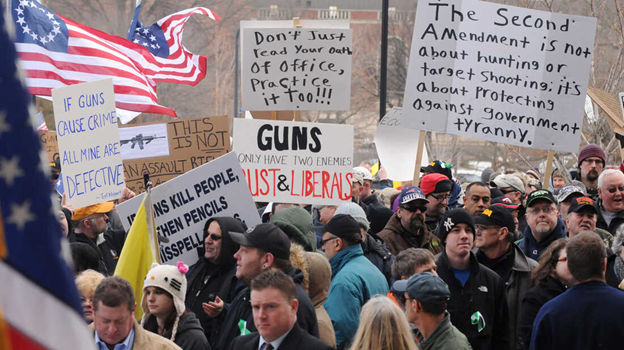
It’s no secret that American culture is uniquely enamored with the liberty/oppression value, as evidenced by strong libertarian representation at all levels of U.S. government, a group which is made up of are some of the staunchest opponents to gun control. Unrestricted gun ownership tends to harmonize with the Liberty value in two ways. First, the Liberty value asserts that individuals should be free to do whatever they want as long as it doesn’t hurt others. It follows that gun ownership should be unrestricted, and only the improper use of guns should invite legal sanction.
Second, many libertarians view gun ownership as a way to protect ‘the people’ from a tyrannical government. Freedoms are never guaranteed; as Thomas Jefferson famously remarked, “the tree of liberty must be refreshed from time to time with the blood of patriots and tyrants.” Many Americans believe that the only way to defend their freedoms is if would-be tyrants fear the people. Therefore, the argument goes, widespread gun ownership is good for society. Likewise, many libertarians view gun control efforts with suspicion, precisely because it could be the opening salvo of a further crackdown by an overbearing government.
Source
Since libertarians are relatively unswayed by the Care value (i.e. causing pain is wrong, especially to the vulnerable), listing the harms of gun violence is unlikely to be persuasive. As well, it would be difficult to pass lasting gun control measures without the acquiescence of many libertarians, given their political activism and their political influence in the Republican party (which controls the government about half of the time). That being said, a pro-gun control government could consider advancing policies that account for the Liberty value, potentially leading to more success. These initiatives might include:
A focus on handguns over assault-style weapons. Given that 63% of Americans are in favour of a ban on assault-style weapons, it might be tempting to focus gun control efforts here. However, since assault-style weapons would likely be the most effective in a justified insurrection against tyranny, values analysis would expect that libertarians would strongly oppose such a ban. In contrast, handguns are unlikely to be particularly useful in such an environment, so libertarians might be more open to restrictions on handgun ownership. Of course, a full ban is out of the question: only 25% of American support a full ban on handguns. However, broadly popular measures (e.g. expanded background checks) may be more acceptable to libertarians if they were restricted to handguns. Since the vast majority of murders are committed with handguns, liberals may be amenable to this tactic as well.
The establishment of free training programs that encourage responsible firearm ownership to complement limited gun control. Lax gun control laws are often justified by citing examples of peaceful European countries with high rates of gun ownership. Finland has a firearm homicide rate of only 0.2 per 100,000 people (compared to 11.9 per 100,000 people in the U.S.), despite having plenty of guns to go around. However, a large number of countries with many guns and little violence (e.g. Switzerland, Austria, Norway) have something else in common: conscription, which leads to high levels of gun literacy. Gun owners in these countries have been trained in the proper use and care of firearms. They aren’t just buying them at their local shop on a whim.
Taking inspiration from these countries, libertarians may be more comfortable with limited gun control if a greater proportion of the population was properly trained in the use of firearms. To address libertarian reasoning, if a tyrannical government takes control, a broader subset of the population would have the skills necessary to resist oppression. In addition, these training programs could encourage the right kind of gun ownership (rifles stored in a locked safe rather than loaded handguns thrown in a glovebox or laying around for kids to find). This would allow for safer gun proliferation, a key goal of libertarian activists. Finally, the establishment of gun training programs would help the U.S. government communicate its agenda. A government that wants to take citizens’ guns away doesn’t teach people how to use them.
Liberals may also be amenable to this approach, as they are not necessarily opposed to all guns. Above all, liberals tend to want to reduce harm. If gun ownership can be delinked from gun violence (as appears to have occurred in several European countries), gun control becomes less pressing. Consequently, instituting U.S. gun training programs as a rough substitute for conscription could harmonize with the Care value. In addition, such programs could reduce the rates of accidental gun death. For example, since the average gun owner in Switzerland is highly trained, the country enjoys an extremely low rate of accidental deaths by firearm. A broader suite of training options in the U.S. could lead to fewer deaths and injuries.
Loyalty (i.e. people have special moral responsibilities to in-group members)
To many U.S. conservatives, guns are an important part of the American national identity – a sign of being part of the “in group,” and by extension somehow fundamentally “American”. Examples of this can be found everywhere in American popular culture, such as this (well-reviewed) t-shirt from Amazon, which is clearly targeting the libertarian/conservative demographic.

I encourage you to have a quick look at the Amazon page for the designer of this t-shirt, Tactical Pro Supply, as it oozes with the Loyalty value. I’ll let the company describe itself:
Proudly Made In USA Tactical American T-Shirt – Our patriotic apparel company is based entirely in the United States of America. We are family owned and operated, and we believe in good old-fashioned red, white, and blue values. Pride in country, pride in self, and pride in our products. Best of all, we keep jobs in ‘MERICA!
Not only are these t-shirts made in the U.S., but Tactical Pro Supply donates a portion of each sale to the PTSD Foundation of America, which helps veterans manage the effects of Post-Traumatic Stress Disorder. This proves that it’s not only fedora-wearing, avocado toast-eating millennials who care about the moral stances of the businesses they frequent.
Building support for gun control with people who see guns as a part of their national identity would require a different approach than with libertarians. Under the Loyalty value, there is little distinction between handguns and long guns (in fact, handguns might be preferred), but opposition to gun control would be less ideological as well. Policy recommendations include:
Selecting your spokespeople carefully. In the polarized political atmosphere of the U.S., even fellow Americans can easily be categorized as outsiders, so lectures from a big-city liberal are unlikely to resonate with conservatives who rely strongly on the Loyalty value. In fact, such advocacy is more likely to be counterproductive, as conservatives may view their identity as under attack and dig in their positions. In addition, conservatives are likely to view these activists as deluded and out of touch with “real” America.
Rather, a pro-gun control government should use spokespeople with impeccable American bonafides: veterans, farmers, and even proud gun owners. In communicating gun control efforts, these types of spokespeople should have their voices amplified (there is already a Veterans for Gun Reform lobby group). Values analysis predicts that these individuals will be more convincing to gun control opponents, as they are more clearly part of the “in group”.
A focus on the Americanness of victims of gun violence alongside their innocence. In my previous post, I discussed a recent article by David Frum in the Atlantic, in which he advocates for a new communications strategy for gun control that focuses on victims of violence in order to convince Americans to stop buying firearms. However, Mr. Frum’s strategy appears to focus primarily on telling the stories of innocent victims, such as children and teenagers, to resonate with the Care value. As mentioned previously, this strategy is important and is likely to be effective for certain individuals.
However, this approach could be improved with an added focus on the Americanness of victims to accent their membership in the “in group” and to create an argument that guns specifically hurt ‘true’ Americans. For example, telling stories of veteran suicides as a justification for limited gun control efforts (such as prohibiting people with mental illness form purchasing firearms) will resonate with a different subset of the population, leading to broader acceptance of the efforts. Interestingly, but unsurprisingly, this opportunity was not taken by the Biden campaign in its plan for gun control, in which the term “veteran” does not even appear.
Fairness (i.e. people should be treated in similar ways and/or people should get what they deserve)
The Fairness value should be central to all policy analysis, because it is the only value that is important to all three main political persuasions (liberals, libertarians, and conservatives). In other words, no matter who you are, Fairness is important to your moral outlook. Applied to the American firearms landscape, Fairness would suggest that any effort to restrict gun proliferation should punish poor behaviour and that responsible gun owners should be impacted as little as possible. One possible gun-control policy that does not violate the Fairness value is:
More restrictive gun storage laws. Under Fairness, responsible gun owners shouldn’t be forced to jump through hoops to buy more firearms. The laws could instead focus on promoting actions that all responsible firearm owners already take. Some states already have laws on the safe storage of weapons, and polls suggest that Americans are by-and-large supportive of such laws. Under these rules, responsible weapon owners aren’t affected, as they already lock and store their weapons properly.
A key element of these laws must be fair enforcement. One minor mistake that happens to be noticed by authorities should not outweigh a long history of responsible ownership. A potential system for enforcement is a three-strike law: first offense is a warning, the second is a fine, and the third is the loss of the weapon and restrictions on further purchases. In addition, gun owners could be punished if their unsecured weapons are stolen and used in a crime; several states (including pro-gun Texas) have similar laws on the books. However, such an approach would need to be carefully crafted, as victims of gun theft should not be incentivized to hide the crime from authorities.
Conclusion
Each of the ideas above is far from ready for implementation. All the other tools of policy analysis (e.g. cost-benefit analysis, communications/demographic analysis, political feasibility studies) would still need to be done. It may turn out that all five ideas are impractical, but I never pretended that values analysis was the silver bullet that would solve all problems. I believe this article has demonstrated how values analysis can promote creative policy design. It is one additional tool that should be pulled out when necessary. Let’s reach for it more often.